Wall-mounted Mechanical, Electrical, and Plumbing (MEP) systems represent high-liability installations in modern construction. When you under-specify pipe brackets, you risk structural damage. You also invite severe system vibration and highly expensive rework. Mechanical layout requirements frequently clash against structural engineering realities. MEP professionals naturally focus on optimal fluid flow and efficient pipe routing. Meanwhile, structural engineers must rigidly defend wall load-bearing limits. Bridging this critical gap ensures safe and compliant projects.
This article details a strict evaluation framework for selecting commercial-grade pipe brackets. We will balance vital factors like dynamic load capacities, harsh environmental conditions, and strict code compliance. You will also learn how to evaluate installation efficiency to confidently finalize procurement. By the end, you will know exactly how to specify the right support hardware for your unique project demands.
Key Takeaways
Selecting the right **pipe brackets** requires calculating both static (pipe + fluid) and dynamic (vibration, thermal, seismic) loads.
**Cantilever brackets** are optimal for heavy, multi-tier wall routing, whereas standard **strut channels** offer modular flexibility for lighter, flush-mount applications.
Material specification (e.g., hot-dipped galvanized vs. 316 stainless steel) must align strictly with the installation environment's corrosion risks.
Procurement decisions should require vendor validation against industry codes (ASME, IBC) and offer BIM/Revit-ready specifications to prevent on-site delays.
The Engineering and Financial Stakes of MEP Support Selection
Selecting adequate wall mounts goes far beyond basic component purchasing. It dictates the entire structural integrity of your mechanical runs. Failing to specify the correct hardware introduces severe financial risks. Project timelines suffer greatly when inspectors flag inadequate supports. Failed inspections demand immediate teardowns. They force crews to repeat labor-intensive routing work.
Structural fatigue presents an even greater danger. Improperly supported pipes transfer extreme stress directly into building walls. Over time, heavy fluid loads and micro-vibrations degrade masonry or drywall anchors. This degradation leads to catastrophic failures. Such incidents incur massive liability claims and demand expensive facility repairs.
Cross-disciplinary friction often complicates support selection. Mechanical engineers prioritize system flow. They focus heavily on maintaining proper slope and layout efficiency. Conversely, structural engineers focus strictly on load-bearing capacities. They demand clear proof regarding how much weight a wall can safely handle. You must bridge this communication gap early in the design phase.
Successful bottom-of-funnel (BOFU) specifications require clear criteria. Your chosen hardware must feature verifiable load ratings from the manufacturer. Material longevity must align perfectly against the surrounding environment. Furthermore, brackets must offer significant vertical and horizontal adjustability on site. This flexibility allows tradesmen to accommodate unexpected structural variations quickly.
Evaluating Support Configurations: System Types and Applications
Different routing scenarios demand specific bracket configurations. You cannot apply a universal approach to MEP supports. Understanding the core strengths of each system prevents costly misapplications.
Cantilever Brackets
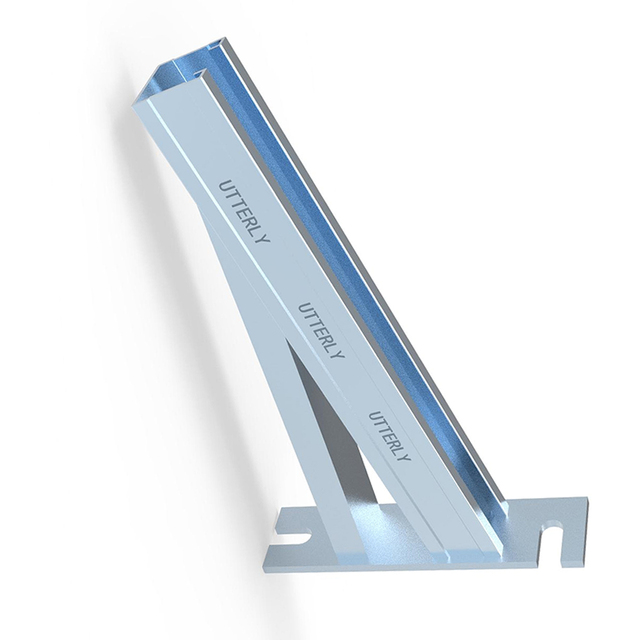
Heavy-duty applications frequently rely on Cantilever Brackets for robust structural support. These units project outward from a wall. They create a strong horizontal shelf for multiple pipe runs. We recommend them highly for heavy HVAC piping and large-diameter chilled water lines.
They provide the necessary standoff distance. This gap allows proper insulation installation around the pipes. It also ensures adequate clearance for maintenance access. When selecting these units, you must evaluate the specific Cantilever Wall Bracket based on its base plate dimensions. A larger base plate distributes moments of force more evenly across the wall surface. Always verify the manufacturer's maximum moment-load limits before approval.
Strut Channels (Surface Mounted)
For modular and scalable support, Strut Channels offer exceptional versatility. Crews mount these tracks directly flush against the wall. They serve as the foundational grid for securing various mechanical components.
This configuration excels in lightweight conduit routing and vertical pipe risers. Flush-to-wall mounting maximizes available corridor space. Selection logic dictates a careful assessment of gauge thickness. Thicker steel gauges prevent channel warping under sustained loads. You must also verify compatibility regarding standard strut-nut accessories. Standardized channels allow rapid installation using generic spring nuts and pipe clamps.
Clevis Hangers & Split Ring Clamps
Sometimes you must suspend pipes outward from the primary brackets. Clevis hangers and split ring clamps serve this exact purpose. Trades attach them directly to cantilever arms or strut framing.
These hangers excel in single pipe runs. They offer crucial vertical adjustability through threaded rods. This feature proves invaluable when installers need to achieve precise pipe slopes for drainage. They also suspend pipes freely, accommodating thermal movement effectively.
Table 1: Support Configuration Comparison
System Type
Ideal Application
Primary Advantage
Key Limitation
Cantilever Brackets
Multi-pipe runs, heavy HVAC
High standoff distance, heavy load capacity
Induces high moment-stress on walls
Strut Channels
Flush-mount risers, conduit
High modularity, low spatial footprint
Requires wall surface proximity
Clevis Hangers
Single suspended lines, sloped pipes
Excellent vertical adjustability
Provides minimal lateral restraint
Core Evaluation Framework: Load, Movement, and Environment
Procurement teams must look past basic product dimensions. A rigorous evaluation framework guarantees long-term safety. You must analyze loads, accommodate physical movement, and respect the installation environment.
Calculating True Load Parameters
Many engineers mistakenly specify brackets based solely on empty pipe weight. This common oversight leads to rapid structural failure. You must calculate the true operational load.
Empty Pipe Weight: The baseline mass of the metal or plastic piping itself.
Operational Fluid Weight: The added mass of water, steam, or chemicals moving through the system.
Testing Loads: The extreme temporary weight experienced during hydrostatic pressure testing.
Hydrostatic testing often fills gas lines or empty conduits entirely with water. This temporarily doubles or triples the expected weight. Your selected bracket must endure these peak testing loads without yielding.
Handling Thermal Expansion & Vibration
Pipes physically grow and shrink as temperatures fluctuate. Rigidly mounting hot pipes directly to steel brackets guarantees trouble. The expanding pipe will eventually snap the fasteners or tear the bracket off the wall.
You must integrate expansion allowances. We strongly advise using roller supports. You can also mount PTFE slide plates on top of your brackets. These smooth surfaces allow pipes to glide horizontally during thermal cycles. This simple addition eliminates harmful shear stress on the wall anchors.
Vibration represents another invisible threat. Pumps and chillers send continuous tremors down the pipeline. Unchecked vibration creates excessive noise inside the building. It also degrades anchor bolts over time. You must integrate rubber-lined clamps or specialized vibration isolators. These components absorb kinetic energy before it reaches the building structure.
Corrosion and Material Specification
Matching your bracket material to the environment is non-negotiable. Using standard indoor hardware outside results in rapid rusting. You must specify the correct metallurgical makeup.
Electro-Galvanized Steel: Suitable strictly for dry, climate-controlled commercial interiors.
Hot-Dipped Galvanized (HDG) Steel: Necessary for outdoor installations. The thick zinc coating resists rain and moderate humidity.
304/316 Stainless Steel: Mandatory for chemical plants, coastal regions, and hygienic food-processing spaces. 316 stainless resists severe chlorides and harsh washdown chemicals.
Validating Code Compliance and Structural Standards
Manufacturers often make bold marketing claims regarding load capacities. You must cut through the marketing noise. Demand hard data based on established engineering codes.
Industry Benchmarks
Reputable vendors test their products against strict international standards. You should require compliance data aligning perfectly with ASME B31 standards for pressure piping. This code governs the safe design of piping installations.
Additionally, seek validation against MSS SP-58 and MSS SP-69 standards. These specific documents regulate pipe hanger and support manufacturing. They dictate acceptable materials, design standards, and allowable stress limits. Approving hardware lacking these certifications exposes your firm to immense legal liability.
Seismic Considerations
Geographic location heavily dictates support requirements. Facilities in earthquake-prone regions demand specialized engineering. Standard vertical load calculations no longer suffice.
You must account for lateral sway and violent horizontal forces. Codes like the International Building Code (IBC) mandate rigid seismic bracing. You must integrate transverse and longitudinal sway braces directly into your wall setups. A heavy-duty bracket provides an excellent anchoring point for these critical seismic components.
Data Transparency
Never accept "estimated" weight capacities from a sales brochure. Unscrupulous suppliers occasionally guess their load limits based on competitor data. This practice endangers your entire project.
Advise your procurement buyers to demand certified load-test sheets. Reputable manufacturers employ independent laboratories. These labs crush and bend the brackets using hydraulic presses. They record the exact yield and failure points. Reviewing these certified documents guarantees you get exactly what you specify.
Implementation Realities: BIM Integration and Site Efficiency
Even the strongest bracket fails if crews cannot install it efficiently. Modern construction moves at a blistering pace. Your chosen hardware must support digital planning and rapid physical deployment.
BIM and Pre-Construction
Building Information Modeling (BIM) prevents expensive site collisions. MEP systems compete constantly for limited wall space against electrical trays and ductwork. Discovering a spatial clash on site wastes valuable labor hours.
You must select vendors who supply highly accurate Revit families. Their digital product templates must perfectly match the physical hardware. Engineers drop these 3D objects directly into the master digital model. This allows teams to identify and resolve spatial clashes months before pouring concrete.
Labor Efficiency on Site
On-site labor remains the most expensive component of any project. Custom-fabricating supports from raw steel consumes massive amounts of time. Welders must cut, join, and paint every single bracket.
Evaluate your bracket options based strictly on modularity. Prefabricated systems eliminate hot-work permits. Easily adjustable, strut-based configurations reduce cutting and measuring errors. Installers simply bolt the components together using standard wrenches. This plug-and-play approach drastically reduces total labor hours.
Shortlisting Vendors
Finalizing your procurement list involves more than simply checking prices. A cheap bracket costs thousands if it arrives three weeks late. You must evaluate the vendor's total operational capability.
Prioritize suppliers boasting massive local inventory availability. They must absorb your sudden schedule changes effortlessly. Assess their technical engineering support. Will they help you calculate complex seismic loads? Finally, scrutinize their warranty terms. A strong, multi-year warranty signals deep manufacturer confidence.
Conclusion
Specifying wall-mounted MEP supports remains a delicate balancing act. You must harmonize strict structural math with vital environmental protection. You must also adhere relentlessly to established industry codes. Skipping any of these steps invites catastrophic failures and delays. However, applying a rigorous, standardized evaluation framework eliminates these risks entirely.
We advise MEP engineers and procurement managers to act immediately. Audit your current project requirements against dynamic load calculations today. Stop relying on outdated static weight assumptions. Reach out to qualified manufacturers directly. Request their technical submittals, load-tested data sheets, and physical product samples. Ensuring structural integrity before installation begins saves your budget, protects your timeline, and secures your reputation.
FAQ
Q: What is the maximum load capacity of a standard cantilever wall bracket?
A: Capacities vary strictly by profile size, gauge, and wall-fixing method; always refer to the manufacturer's moment-load tables rather than general assumptions.
Q: How do I choose between strut channels and pre-welded cantilever brackets?
A: Use strut channels for scalable, lighter, flush-mount needs. Pre-welded cantilevers are required for high-moment, heavy-duty standoff applications.
Q: Do pipe brackets for MEP systems need to account for thermal expansion?
A: Yes, rigid mounting without expansion allowance causes pipe stress or anchor failure; utilize slide plates or roller attachments for fluctuating temperature fluids (e.g., steam or chilled water).
Q: Can standard galvanized pipe brackets be used outdoors?
A: Electro-galvanized is strictly for dry interiors. Outdoors require Hot-Dipped Galvanized (HDG) or Stainless Steel for legitimate corrosion resistance.
Utterly TY Intelligent Technology Co.,Ltd. is a high-tech private enterprise integrating product design, research and development, sales and installation.