Piping infrastructure carries incredibly high stakes for any commercial or industrial facility. Selecting the wrong hardware inevitably leads to premature wear. It causes failed structural inspections and can trigger catastrophic system breaches. Routing pipes vertically introduces fundamentally different mechanical stresses compared to overhead routing. Vertical shafts battle intense downward shear forces and gravity on a constant basis. In contrast, overhead horizontal runs face tensile loads, lateral sway, and continuous thermal movement. Engineers must respect these unique directional forces to build lasting systems.
We created this guide to deliver a practical, engineering-aligned framework for your next project. You will learn how to evaluate your operational environment properly. We will help you shortlist the exact hardware required for specific load and directional challenges. This process ensures your systems remain secure, compliant, and durable over their intended lifespan.
Key Takeaways
Vertical piping requires friction-based or lug-supported solutions (like Riser Support Clamps) to counteract direct downward shear forces and gravity.
Overhead piping relies on suspension hardware (like Two-Bolt Pipe Clamps) designed to handle tensile loads, lateral sway, and thermal expansion.
Heavy-duty infrastructure often mandates robust hardware like a Split Steel Pipe Clamp to manage high loads, vibration, and extreme operational environments.
Compliance is non-negotiable: Final selection must align with specific industry standards (e.g., MSS SP-58, ASME B31) based on material compatibility and load ratings.
The Physics of the Pipe: Vertical vs. Overhead Load Dynamics
Engineers must anchor their decisions in mechanical realities. You cannot simply browse product categories and hope for the best. System stability depends entirely on managing dynamic forces accurately. You must calculate the exact physical stresses acting upon your infrastructure before specifying any hardware.
Vertical Forces (Shear & Axial)
Vertical runs create intense downward stresses. They transfer the entire weight of the pipe and its internal media directly toward the foundation. Gravity pulls this massive fluid load relentlessly downward. The supporting hardware must grip the exterior wall securely to halt this momentum. It relies heavily on surface friction to prevent the line from slipping.
Thermal growth also creates severe complications in vertical shafts. As fluids heat up, pipes expand longitudinally. They act like massive hydraulic rams pushing against floor penetrations. You need specialized floor penetration support to handle this aggressive upward and downward axial movement safely.
Overhead Forces (Tensile & Lateral)
Horizontal runs behave very differently. They suspend heavy weight across wide open spaces. This configuration creates pure tensile stress on the mounting hardware. You suspend these pipes from ceilings, struts, or structural steel beams. The hardware literally stretches under the load.
Dynamic loads complicate horizontal lines further. Fluid pulsation shakes the surrounding structure continuously. Sudden valve closures cause water hammer, which sends violent shockwaves through the system. Lateral sway occurs during seismic events or exposure to heavy winds. You must account for all these lateral and tensile forces when sizing your suspension rig.
Load Calculation Realities
A critical engineering rule applies across all routing directions. Load calculations must always assume the worst-case operational scenario. You must calculate the weight of the pipe completely full of its heaviest expected fluid. You must add the weight of thick exterior insulation. You must also include potential external burdens like accumulated ice or debris. Never size your infrastructure hardware based on the weight of an empty pipe.
Vertical Solutions: Anchoring with the Riser Support Clamp
Vertical shafts demand a dedicated, structural solution. The Riser Support Clamp handles these intense downward forces perfectly. Installers place this hardware at regular intervals between floors. It transfers the entire vertical load directly to the primary building structure.
Core Functionality
The hardware typically rests securely on concrete floor slabs or heavy structural steel plates. It acts as a massive structural brake. It stops gravity from pulling the line downward through the penetration hole. The broad ears of the clamp spread the immense weight over a larger surface area, preventing structural fatigue in the concrete or steel.
Implementation Realities & Risks
Engineers often debate the safety of friction versus shear lugs. Standard commercial loads rely purely on friction. You torque the bolts tightly, and the metal grips the pipe wall. However, high-pressure industrial lines require a completely different approach. Heavy-wall industrial systems generate extreme downward force that friction alone cannot hold.
To prevent catastrophic slipping, you must weld solid shear lugs directly onto the pipe exterior. The hardware then rests physically against these steel lugs. This physical barrier guarantees the line will never drop, even under maximum thermal expansion.
Common Mistakes and Shortlisting Logic
Installers face serious overtightening risks during vertical installations. Plumbers often apply excessive torque to the bolts. They incorrectly assume tighter is always better. This dangerous mistake easily crushes thin-wall stainless steel lines. It instantly shatters PVC and CPVC plastic piping. Always follow the precise torque specifications provided by the manufacturer.
You must also carefully consider galvanic corrosion during your shortlisting process. Never mix dissimilar metals in damp environments. Choose copper-plated hardware to secure copper tubing. Use standard carbon steel for cast iron or black steel lines. This simple material matching logic extends system longevity significantly.
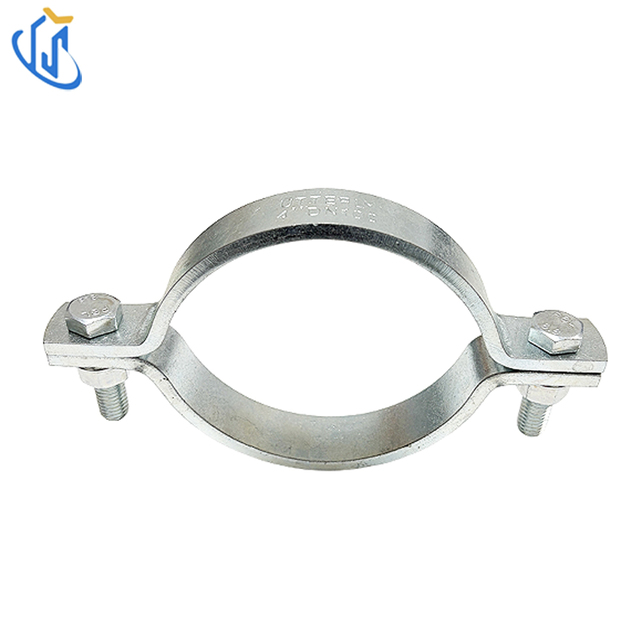
Overhead Solutions: Suspension via the Two-Bolt Pipe Clamp
Horizontal ceiling-suspended pipelines demand highly adjustable hardware. The Two-Bolt Pipe Clamp represents the ultimate industry standard for this application. Installers primarily use it to secure pipes firmly to threaded hanging rods. They also mount it directly to structural framing for tight overhead runs.
Core Functionality
Its dual-bolt design allows for precise tension adjustment. It fully surrounds the pipe, offering a full 360-degree capture. This makes it vastly superior to single-strap alternatives that can warp under heavy tensile loads.
Grip vs. Guide Configurations
You can deploy this hardware in two distinct functional ways. First, you can tighten the bolts fully to grip the pipe tightly. This creates a highly rigid anchor point that stops all movement. Second, you can intentionally leave a slight gap by loosening the bolts. This transforms the hardware into a directional guide. The pipe can now slide back and forth through the ring. This sliding accommodates longitudinal thermal expansion safely without tearing the hanger from the ceiling.
Vibration Management Strategies
Vibration management is a crucial reality for overhead runs. HVAC systems generate a constant, destructive hum. Plumbing runs experience chaotic fluid turbulence. You cannot mount bare steel directly against a rapidly vibrating pipe. The metal will eventually fatigue, score the pipe wall, and fail.
You must specify elastomeric or rubber linings for these scenarios. These thick rubber inserts provide vital acoustical isolation. They absorb and dampen dangerous vibrations before they can reach the ceiling structure above.
Shortlisting Logic
You must know exactly when to choose this hardware over a standard clevis hanger. Clevis hangers allow excessive lateral movement. They suspend the line loosely in a swinging cradle. Choose the two-bolt option when your system demands rigid gripping. It is also the perfect choice for top-down mounting configurations where overhead plenum space is exceptionally tight.
Infrastructure & Industrial Focus: The Split Steel Pipe Clamp
Severe industrial environments destroy standard commercial hardware rapidly. Commercial options simply buckle under extreme industrial stress. The Split Steel Pipe Clamp provides the heavy-duty structural advantage you need. Manufacturers build it entirely from exceptionally thick, heavy-gauge steel. It features reinforced bolting mechanisms designed for maximum torque.
Core Functionality
This hardware easily secures large-diameter infrastructure piping. It wraps around massive chilled water mains or high-pressure steam lines. It provides multi-directional bracing that keeps heavy lines completely immobilized.
Managing Seismic & Wind Loads
Critical infrastructure faces extreme external threats. Seismic activity shifts the earth violently, tearing poorly supported pipes apart. High winds batter exposed exterior pipelines on rooftops or outdoor racks. This heavy-duty clamp provides essential multidirectional rigidity. It locks the system down firmly. It prevents dangerous lateral sway and axial shifting during unpredictable natural disasters.
Corrosion Resistance Priorities
Corrosion poses a constant, aggressive threat in these harsh environments. Chemical processing plants emit highly corrosive vapors. Coastal facilities face endless, destructive salt spray. You absolutely cannot use standard zinc-plated hardware here. It will rust away within months.
You must specify hot-dipped galvanized finishes for outdoor environments. For chemical exposure, you must demand 316 stainless steel. These resilient materials survive harsh outdoor and chemical exposures for decades without losing their structural integrity.
Shortlisting Logic
Specify this robust hardware specifically for the most demanding sectors. Heavy industrial processing facilities need it for chemical routing. Oil and gas refineries rely on it daily to secure volatile media. Large-scale municipal water systems require its immense load capacity to hold massive mains. Standard commercial variants would snap under these operational extremes.
Decision Matrix: Evaluating the Right Pipe Support Clamp
Buyers and specifying engineers need a rapid evaluation framework to make accurate decisions. You must weigh multiple operational variables simultaneously. Choosing the right pipe support clamp means perfectly balancing mechanical strength, environmental resilience, and strict code compliance.
Load Capacity vs. Pipe Material
First, you must match the hardware's documented yield strength to your calculated operational weight. An underrated bracket will warp and snap under pressure. Second, you must guarantee strict material compatibility. Never install bare steel directly onto copper tubing. The resulting galvanic corrosion will destroy the system rapidly. Always verify the manufacturer's load tables against your isometric drawings.
Thermal Expansion Requirements
Determine exactly how your system responds to intense heat or cold. Does the network require rigid, fixed anchor points to force expansion in a specific direction? Do you need to allow for free directional sliding? Select hardware that matches your specific thermal movement strategy. Using rigid hardware on a line that needs to expand will cause the pipe to buckle or tear the support out of the wall.
Installation Environment & Clearances
Physical space dictates your mounting options. Tight vertical building shafts require slim-profile riser solutions that fit snugly against the wall. Open overhead plenums allow for wider, more complex suspension rigs. Always measure your actual physical clearances on the job site before ordering bulk materials.
Code Compliance & Certifications
Regulatory adherence remains absolute. You cannot cut corners on safety certifications. Inspect every specified component for valid UL listings. Verify all FM approvals if you are building fire protection systems. Ensure strict adherence to MSS SP-58 standard load ratings and ASME B31 piping codes.
Pipe Support Evaluation Matrix
Feature Category
Vertical Applications
Overhead Applications
Heavy Industrial
Primary Force
Downward Shear / Gravity
Tensile / Lateral Sway
Multi-directional / Seismic
Preferred Hardware
Riser clamp with or without lugs
Two-bolt clamp or clevis hanger
Split steel clamp (heavy gauge)
Key Risk Factor
Overtightening thin-wall pipes
Ignoring vibration isolation
Galvanic corrosion / Wind loads
Best Practice
Support at every floor penetration
Leave loose for thermal guide
Specify 316 Stainless or Hot-Dipped
Conclusion
Choosing the right hardware comes down to accurately identifying the primary mechanical forces in your system. You must know whether you are fighting axial shear forces in a vertical shaft or tensile forces in an overhead run. You must also evaluate your operational environment for vibration, corrosion, and extreme temperatures.
When engineering these systems, remember that strategic over-engineering is vastly preferable to catastrophic system failure. Never undersize your load capacities to save a fraction of the budget. It simply is not worth the structural risk.
Review your current isometric drawings carefully. Compare your operational loads against official manufacturer load tables. If you encounter complex directional forces or unique environmental challenges, we strongly encourage you to consult your technical sales team or request a physical sample before final installation.
FAQ
Q: What is the main difference between a pipe clamp and a pipe hanger?
A: Clamps typically grip the pipe securely to restrict movement entirely or act as a rigid structural anchor. Hangers, like standard clevis hangers, suspend the pipe loosely from above and often allow for free longitudinal movement and slight lateral sway.
Q: How far apart should pipe support clamps be placed on a vertical run?
A: Spacing is dictated strictly by pipe material, diameter, and local codes. For example, steel piping often requires support at every floor level. Plastics like PVC require much more frequent support to prevent bowing. Always defer to MSS SP-58 or your local building codes.
Q: Can I use a Two-Bolt Pipe Clamp for a vertical pipe?
A: Generally, no. Two-bolt variants lack the extended, reinforced ears required to transfer heavy vertical loads safely onto floor penetrations. Using them vertically risks severe pipe slip and catastrophic system failure.
Q: Do I need isolation pads with a Split Steel Pipe Clamp?
A: Yes. You need isolation pads if there is a risk of galvanic corrosion between dissimilar metals. You also need them if high-frequency operational vibration needs dampening to protect the outer pipe wall from severe abrasion.
Utterly TY Intelligent Technology Co.,Ltd. is a high-tech private enterprise integrating product design, research and development, sales and installation.