Pipeline condensation is not a minor nuisance. It operates as a systemic risk. It triggers Corrosion Under Insulation (CUI). It causes severe facility water damage. It also compromises energy efficiency across HVAC setups and data center cooling environments. Traditional pipe supports create immediate failure points. Uninsulated metal hangers and treated wood blocks form dangerous thermal bridges. They allow ambient moisture to rapidly condense on your chilled water lines.
You need a better standard to secure these systems. The PU Insulated Pipe Clamp serves as the engineered solution you require. We will explore how it provides unbroken thermal resistance while handling heavy structural loads. You will learn the exact metrics for selecting the right supports. We will cover installation realities and specification matching to protect your facility effectively.
Key Takeaways
**Dual Functionality:** High-density PU insulated pipe clamps combine structural load-bearing capacity with continuous thermal barriers, eliminating metal-to-pipe contact.
**System Efficiency:** Proper anti-cold bridge supports directly protect energy efficiency metrics (like data center PUE) by preventing thermal loss at support locations.
**Evaluation Metrics:** Procurement decisions should be based on thermal conductivity (k-value), closed-cell material density, fire safety compliance, and weight-bearing ratings.
**Installation Reality:** While unit costs may be higher than traditional wood blocks, integrated PU clamps drastically reduce labor time and vapor barrier failure risks.
The Business Cost of Cold Bridges in Chilled Water Systems
A cold bridge occurs when conductive materials interrupt your pipeline insulation. Heat transfers rapidly across these uninsulated gaps. The pipeline surface temperature subsequently drops below the local dew point. Ambient moisture immediately condenses on the exposed support structures. This thermal bridge mechanism acts as a continuous drain on system performance.
The operational consequences disrupt long-term facility stability. Industry professionals frequently battle three major issues caused by these failing supports.
CUI (Corrosion Under Insulation): Moisture accumulation steadily degrades the pipe. Water gets trapped under adjacent insulation layers. The metal pipe corrodes silently away from visual inspection. CUI remains notoriously difficult to detect. By the time maintenance spots pooling water, the pipe wall thickness often degrades beyond safe operational limits.
Energy Loss: Thousands of uninsulated support points exist across large facilities. They incrementally drain HVAC compressor efficiency. Your chillers work harder to compensate for this continuous thermal leakage. In modern data centers, this directly harms your Power Usage Effectiveness (PUE) metrics. Every kilowatt wasted cooling the ambient room air increases utility burdens.
Safety & Compliance: Dripping condensation creates severe slip hazards on facility floors. In server rooms, falling water directly threatens sensitive electronic racks. Facility managers face serious compliance violations when uncontrolled moisture persists inside commercial zones.
Traditional workarounds frequently fail at the decision level. Contractors historically used treated wood blocks. Wood naturally absorbs moisture over time. It rots, shrinks, and loses structural integrity. Other installers overlap standard rubber insulation. Rubber lacks adequate compressive strength. Heavy pipes crush the rubber down to a fraction of its original thickness. This compression destroys its thermal resistance entirely.
How a PU Insulated Pipe Clamp Solves the "Support vs. Insulation" Dilemma
Engineers demand a product capable of doing two things simultaneously. They need structural support. They also require uninterrupted thermal resistance. A high-quality PU Insulated Pipe Clamp solves this exact dilemma.
Polyurethane (PU) features a specialized closed-cell structure. Open-cell materials act like sponges absorbing vapor. Closed-cell PU acts like an impenetrable fortress. This molecular design prevents moisture permeability almost completely. The rigid cells trap inactive gases inside. This layout delivers exceptionally low thermal conductivity. Furthermore, high-density PU offers immense compressive strength. It resists deformation under massive pipe weights.
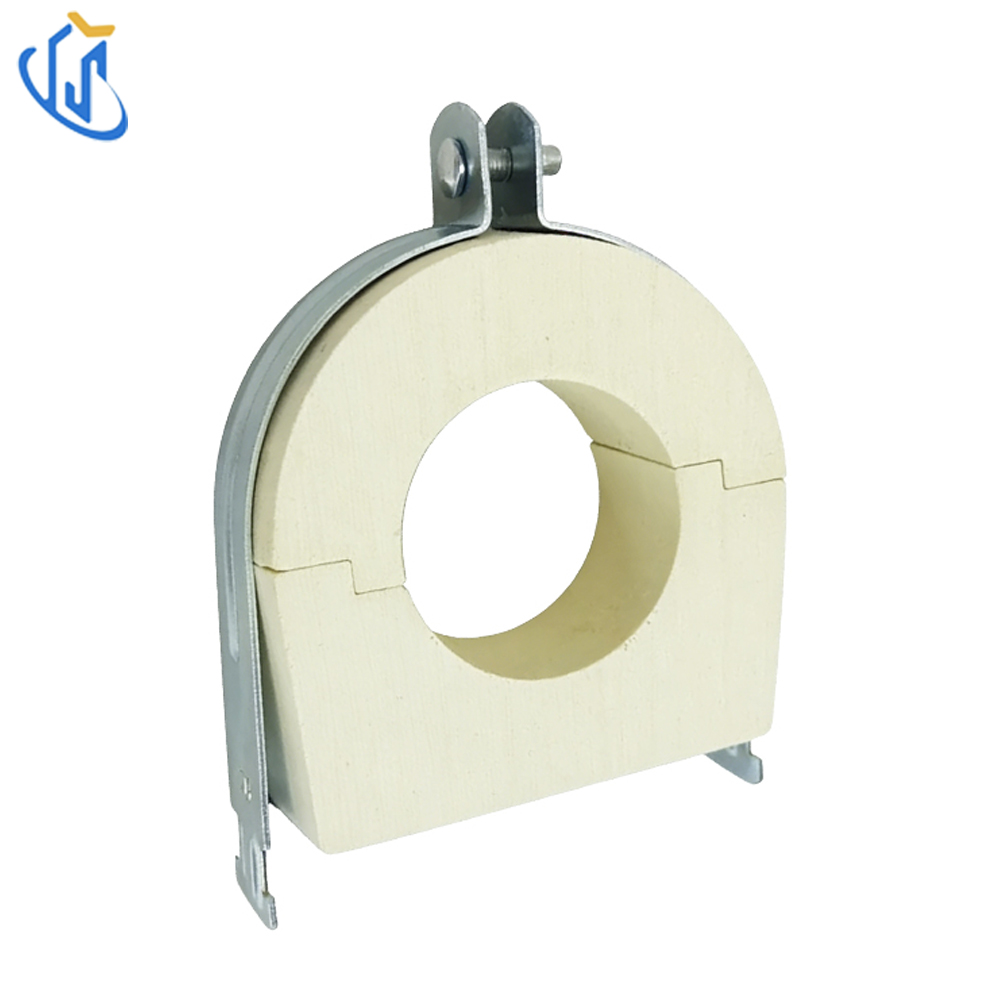
Commercial variants utilize all-in-one engineering. The anatomy includes three critical layers. First, you have the rigid PU core holding the pipe. Second, an outer steel ring provides the structural anchor. You can choose galvanized or stainless steel based on conditions. The metal band distributes the mechanical point-load evenly across a wider surface area. Third, manufacturers integrate a continuous vapor barrier layer directly onto the PU core exterior.
This execution effectively guarantees anti-cold bridge performance. The PU core acts as an absolute isolator. The pipe's internal operating temperature never interacts with the ambient room air. The metal hanger transfers structural loads smoothly into the building framework. It never physically touches the chilled pipe. You eliminate the thermal bridge entirely.
Key Evaluation Criteria for Anti-Cold Bridge Pipe Supports
You must evaluate pipe supports using strict engineering metrics. Do not rely on generic visual inspections. We recommend analyzing thermal, structural, and safety data carefully.
Core Evaluation Metrics Summary
Evaluation Metric
Standard Requirement
Engineering Impact
Thermal Conductivity (k-value)
Typically ≤ 0.035 W/(m·K)
Determines acceptable heat transfer rates. Lower values signify superior insulation performance for chilled lines.
Material Density
80 - 300 kg/m³
Matches structural load capabilities. High density prevents material crushing under heavy commercial piping constraints.
Fire Rating Compliance
UL / ASTM E84 Class A
Ensures the material limits flame spread. It controls smoke development during unexpected facility fire incidents.
Matching your PU density to the specific application remains critical. You must account for the static pipe weight. You must add the internal fluid weight. You must also factor in dynamic system loads. Water hammer events create sudden pressure spikes. When a valve closes quickly, the shockwave creates a massive dynamic load on the pipe hanger. Weak insulation crushes instantly. Standard commercial lines generally require PU densities between 80 and 160 kg/m³. Heavy industrial risers demand densities reaching up to 300 kg/m³.
Dimensional accuracy guarantees your success. Pay attention to these three exact sizing factors:
Inner Diameter (ID): The clamp's ID must match the pipe's outside diameter perfectly. Loose fits cause damaging friction. Tight fits damage the pipe wall.
Outer Diameter (OD): The clamp's OD must align seamlessly flush against your adjacent mainline insulation.
Insulation Thickness: The PU thickness must mirror the connecting elastomeric or fiberglass insulation thickness. Uneven transitions create immediate condensation risks.
Fire ratings dictate your environmental compliance. Commercial HVAC bids strictly require certified fire-retardant materials. Always check for ASTM E84, UL certifications, or equivalent local standards. Non-compliant materials expose your facility to massive liability risks during safety audits.
Implementation Realities: Installation Efficiency and Failure Risks
Installation standardized methods define your final project quality. Finding skilled insulators proves increasingly difficult today. Integrated PU clamps drastically reduce multi-step blocking routines. Installers execute a single, repeatable fastening action. This standardized workflow minimizes human error across large construction sites. It reduces reliance on artisan-level craft skills. You save thousands of labor hours on extensive pipeline networks.
Vapor barrier continuity represents your main implementation risk. The joint connecting your pipe insulation to the PU clamp requires perfect sealing. You must apply compatible mastics. You must wrap the seam tightly using overlapping aluminum vapor tape. Failure here completely negates the clamp's value. Ambient moisture will aggressively penetrate any unsealed micro-gap.
Best Practices for Installation
Apply wet mastic fully around the insulation joint before pressing it against the clamp core.
Extend your aluminum vapor tape at least two inches past the connecting seams on both sides.
Position the clamp's load-bearing hinge properly according to manufacturer load orientation guidelines.
Common Mistakes to Avoid
Leaving a visible air gap between the main run insulation and the rigid PU core block.
Using incompatible adhesives. Wrong chemicals rapidly degrade the polyurethane material over time.
Overtightening the outer steel ring. Excessive torque fractures the closed-cell internal structure.
Complex environments demand additional considerations. Pump rooms create intense high-vibration zones. You need heavy-duty outer clamps featuring locking nuts to prevent loosening. Outdoor bridge-spanning pipes face severe UV degradation and weather exposure. You must specify UV-resistant exterior jacketing for these locations. Tight ceiling plenums require low-profile designs. Plenums operate as cramped, hot spaces. They remain difficult to access for future maintenance. You must secure these areas right the first time.
Shortlisting Logic: Selecting the Right PU Insulated Pipe Clamp
Selecting the right hardware demands methodical specification matching. You cannot treat pipe supports as generic hardware commodities.
First, verify your pipe material compatibility. Copper pipes running standard chilled water interact differently than heavy carbon steel lines. PVC or CPVC piping requires specific load distribution configurations to prevent point-loading fractures.
Second, define your medium temperature. Deep freeze refrigeration lines require distinct vapor barrier treatments compared to standard HVAC chilled water. Cryogenic systems demand the absolute highest density PU variants. They prevent devastating thermal shock. Standard lines allow slightly lower densities.
Third, assess your environmental corrosivity. Standard indoor commercial buildings safely utilize electro-galvanized outer steel clamps. Coastal facilities or chemical processing plants present highly corrosive atmospheres. Washdown areas require intensive protection. These extreme environments dictate the use of 316 stainless steel outer hardware. A PU Insulated Pipe Clamp featuring robust stainless steel housing guarantees long-term structural integrity in harsh zones.
Finally, conduct rigorous vendor vetting. Demand actual load test data from the manufacturer. Request independent thermal performance certificates verifying the claimed k-values. Examine their catalog for clear SKU naming conventions. An ideal SKU indicates pipe diameter, insulation thickness, and material type in one string. This logical system prevents costly site delivery errors. Authentic engineering data separates reliable manufacturers from low-tier commodity suppliers.
Conclusion
Treating pipe supports as an afterthought jeopardizes your multi-million-dollar HVAC investments. Condensation destroys insulation integrity. It introduces severe corrosion risks. It wreaks havoc on operational energy metrics.
Mandate strict standards: Update your engineering specifications to require closed-cell, high-density PU insulated pipe clamps at all cold-system support locations.
Verify dimensional fit: Ensure inner diameters and insulation thickness match your mainline piping precisely to eliminate thermal gaps.
Enforce vapor barriers: Train your installation teams to perfectly seal all connecting seams using approved mastics and overlapping aluminum tapes.
Audit current designs: Review your pending projects immediately. Remove outdated wood blocks or uninsulated hangers from your schematics.
Take immediate control of your pipeline integrity. Consult verified load-rating tables before your next project. Request a technical sample from a trusted manufacturer today. Protect your facility against the relentless threat of uncontrolled condensation.
FAQ
Q: What is the difference between PU pipe clamps and treated wood blocks?
A: PU clamps feature a specialized closed-cell structure providing absolute moisture resistance and predictable thermal conductivity. They never absorb water. Treated wood blocks consist of organic material. Wood naturally absorbs ambient moisture over time. This leads to internal rot, structural decay, and eventual thermal bridge failure.
Q: Can a PU Insulated Pipe Clamp support the weight of large-diameter commercial steel pipes?
A: Yes. Manufacturers engineer high-density PU to scale seamlessly alongside pipe sizes. Standard densities handle light lines. Larger commercial steel pipes utilize ultra-high-density PU variants reaching up to 300 kg/m³. This precise scaling delivers immense compressive strength. It prevents any structural crushing under massive dynamic loads.
Q: How do you prevent condensation at the seams of the PU clamp?
A: You must perfectly seal the critical joint where the mainline insulation meets the rigid PU core. Installers prevent condensation by applying compatible wet mastics directly into the seam. They must finish the joint by wrapping overlapping aluminum vapor tape tightly across the entire transition zone.
Q: What temperature ranges are suitable for high-density PU pipe supports?
A: High-density PU supports safely operate across extreme thermal gradients. Standard operational ranges handle deep cryogenic refrigeration applications up to standard hot water limits. Most premium PU materials reliably sustain continuous operations between -160°C and +120°C without suffering structural degradation or losing thermal resistance.
Utterly TY Intelligent Technology Co.,Ltd. is a high-tech private enterprise integrating product design, research and development, sales and installation.