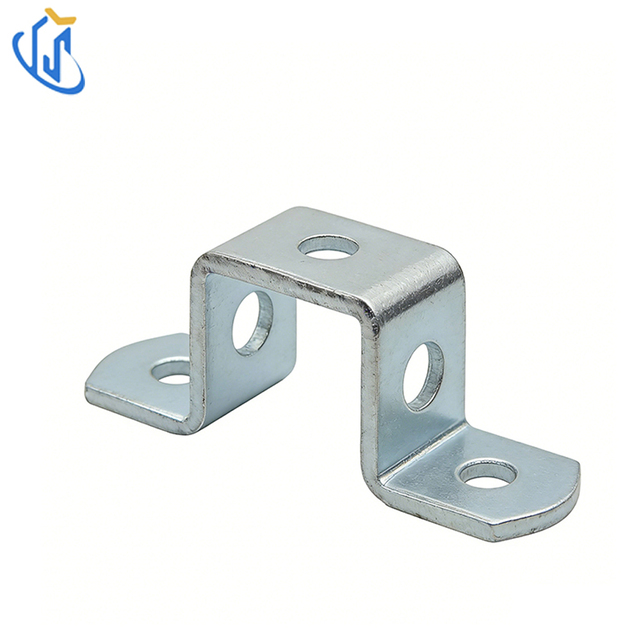
Inadequate supports in heavy-duty industrial piping carry severe structural risks. Rampant vibration, catastrophic load failures, and premature material fatigue often result from poor hardware choices. We regularly see commercial infrastructure projects halt due to improperly secured fluid lines. A reliable Square Saddle Clamp solves these mechanical issues. It excels when securing cylindrical pipes to square profiles, strut channels, or handling square tubing. These specialized brackets anchor heavy-weight conduits directly to flat structural members without dangerous slippage. This guide equips engineers and procurement teams with a clear, specification-driven framework. You will learn how to evaluate and source zinc-plated brackets for commercial and industrial applications. We cover crucial sizing metrics, load capacities, environmental limits, and standard installation practices. This ensures your next piping network remains robust, compliant, and stable over its entire operational lifespan.
Key Takeaways
Square saddle clamps provide superior surface-area contact compared to standard U-bolts, reducing point-load stress on heavy-duty pipes.
Zinc plating offers a cost-effective anti-corrosion barrier ideal for indoor or controlled industrial environments, but has strict limitations in highly acidic or marine settings.
Accurate specification requires matching the exact outer diameter (OD) of the pipe, not just the Nominal Pipe Size (NPS), while accounting for thermal expansion.
Reliable implementation depends on strict adherence to torque specifications for bolted configurations to prevent pipe deformation and ensure long-term stability.
Framing the Business Problem: When to Specify a Square Saddle Clamp
Let us examine the mechanical limitations of standard hardware. Standard round U-bolts struggle immensely to grip square structural beams. Single-hole pipe straps lack the necessary rigidity against lateral pipe movement. If a heavy-duty fluid line shifts horizontally, round fasteners slide out of alignment. This sliding creates immense stress on pipe joints and welds. Traditional hardware relies on minimal point contact. This concentration of force often damages thin-walled pipes. When securing heavy systems, you need hardware built specifically for flat structural profiles. Strut channels often bend under extreme lateral pressure if the fastener cannot grip the sides properly. The square saddle prevents this by locking around the channel edges.
A Square Saddle Clamp offers a distinct mechanical advantage. The square geometry provides flush mounting against flat structural supports. It distributes clamping force evenly across a much larger contact area. This physical design reduces point-load stress on the pipe itself. A flush mount eliminates the rocking motion common with standard U-bolts. You gain unmatched stability during sudden pressure surges. The bracket hugs the square profile tightly. This locks the conduit firmly in place, mitigating harmful vibration propagation.
Primary applications for this specific hardware include:
Structural steel framing attachments in industrial facilities.
Heavy HVAC conduit routing across open warehouse ceilings.
Industrial fluid transport systems requiring rigid stabilization.
Strut channel assemblies where vibration control is mandatory.
Pneumatic delivery lines running along square structural pillars.
Evaluating Zinc-Plated Finishes: Capabilities and Limitations
We must establish a baseline for corrosion resistance. Zinc plating typically utilizes an electro-galvanization process. This involves immersing the steel in a zinc salt solution and applying an electrical current. It provides a sacrificial anodic layer. This chemical layer protects the underlying carbon steel from oxidation. When moisture hits the bracket, the zinc corrodes first. This sacrificial action keeps the core steel structurally sound. It acts as a highly effective, low-cost barrier against ambient humidity.
Let us compare zinc-plated clamps to alternative finishes. A 304 or 316 stainless steel bracket offers extreme chemical resistance. However, a zinc-plated Square Saddle Clamp remains highly cost-effective for standard industrial use. It bridges the gap between raw steel and expensive alloys. Compared to hot-dip galvanized hardware, electroplated zinc offers tighter dimensional tolerances. These precise tolerances are crucial for threaded bolted clamps. Hot-dip galvanization immerses the steel in molten zinc, creating a thick, clumpy layer. This often clogs threaded bolt holes. Electroplating ensures smooth thread engagement during installation. The primary downside is a significantly thinner protective coat.
Finish Type
Corrosion Resistance
Thread Tolerance
Ideal Application Environment
Electroplated Zinc
Moderate
Excellent (Tight)
Indoor, Dry, Climate-Controlled
Hot-Dip Galvanized
High
Poor (Uneven)
General Outdoor, High Moisture
304/316 Stainless
Extreme
Excellent
Marine, Chemical Processing, Washdown
Environmental suitability demands an evidence-based approach. We strongly recommend zinc-plated brackets for indoor facilities. They perform flawlessly in dry manufacturing environments and climate-controlled warehouses. You must avoid them for continuous outdoor marine exposure. They also fail rapidly in high-chemical environments. Acidic atmospheres strip the thin zinc layer away in weeks. Always assess your facility's specific microclimate before ordering hardware.
Beware of severe galvanic corrosion risks. You should never pair zinc-plated carbon steel directly against copper piping. Avoid direct contact with raw stainless steel piping as well. These dissimilar metals react electrically in the presence of any moisture. The zinc layer will rapidly deteriorate. Always use rubber linings, neoprene pads, or dielectric tape. These materials isolate the metals and prevent destructive electrical reactions.
Sizing and Load Capacity Criteria
Dimensional accuracy dictates the success of your installation. The most common procurement error involves Nominal Pipe Size (NPS). Procurement teams often order hardware based on NPS alone. This leads to costly delays on the job site. A Square Saddle Clamp must fit the exact Outer Diameter (OD). If your pipe uses thermal insulation, you must measure the outside of the insulation jacket. The same rule applies if you use isolation pads. For example, if a pipe OD is 4 inches, a half-inch isolation pad adds 1 full inch to the final OD. Ordering a standard 4-inch bracket will completely fail. Always calculate the final, fully assembled OD before specifying your hardware size.
We must clearly differentiate between static and dynamic loads.
Static Load: This represents the constant dead weight. It includes the physical pipe material and the maximum weight of the fluid inside it. This forms your absolute baseline load requirement.
Dynamic Load: This introduces complex, shifting variables. Fluid surge forces create sudden pressure spikes. Connected machinery generates constant, rhythmic vibration. Thermal expansion causes horizontal and vertical shifting. Dynamic loads often exceed static loads during peak operations.
Material thickness and width directly correlate to maximum load ratings. A heavier steel gauge resists bending under extreme dynamic stress. It prevents the bracket from snapping during sudden pressure surges. A wider saddle band distributes the load across more surface area. This prevents localized deformation of thin-walled pipes. When dealing with schedule 10 stainless lines or copper tubing, you need a wider saddle band. A narrow band acts like a knife edge under heavy loads. It can easily crush softer pipe materials.
Implementation Risks and Installation Standards
Industry standard compliance guarantees long-term safety. You must verify your brackets meet relevant piping support standards. Look for documented compliance with MSS SP-58 or equivalent local industrial codes. This specific standard governs pipe hangers and supports for demanding industrial operations. It establishes strict safety factors for yield strength and material fatigue over thousands of vibration cycles. Do not guess on weight capacities. Never rely on visually estimating structural strength. Demand engineered proof indicating the hardware can support your specified loads.
Torque specifications for bolted types require strict adherence. This represents a harsh installation reality. Over-tightening bolts can crush thin-walled pipes instantly. It can also permanently strip the threaded ends of the Square Saddle Clamp. Under-tightening is equally dangerous for system stability. Loose bolts allow vibration-induced slippage over time. The pipe gradually shifts out of alignment. Always mandate the use of a calibrated torque wrench. Follow the manufacturer's exact inch-pound torque recommendations during assembly.
Vibration and thermal movement demand proactive mitigation strategies. Piping systems naturally expand and contract as ambient temperatures fluctuate. If the setup rigidly locks the pipe in place, thermal expansion causes immense structural stress. The pipe may buckle or tear the support directly from the ceiling. You can use specialized slide guides to allow engineered directional movement. Sometimes, installers only tighten the bracket enough to act as a loose guide. This permits horizontal travel while preventing vertical sagging.
Shortlisting Logic for Procurement
Procurement requires extensive documentation and meticulous traceability. Buyers must require Technical Data Sheets (TDS) from prospective suppliers. A reliable TDS should explicitly list the ultimate yield strength and the recommended safe working load. This allows engineers to build in appropriate safety margins for unpredictable dynamic events. Ask for comprehensive, lab-tested load capacity charts. Request official material certifications before authorizing any bulk purchases. This documentation prevents severe liability issues later. It ensures you receive the exact steel grade and zinc thickness you paid for.
You must evaluate the choice between customization and off-the-shelf parts. Standardized catalog dimensions offer significantly faster lead times. They also provide proven matrix data for load limits based on historical testing. However, non-standard square profile dimensions might require custom fabrication. Custom orders take longer to process and manufacture. Yet, they guarantee a perfect mechanical fit for unique structural beams. Weigh your project timeline against the need for specialized structural dimensions.
Follow these essential next steps to finalize your specification sheet:
Identify the exact environmental exposure, noting humidity levels and potential chemical presence.
Calculate both the static dead weight and anticipated dynamic load requirements.
Measure the exact Pipe Outer Diameter (OD), including all external insulation and rubber padding.
Define the required torque specifications for safe, damage-free installation.
Verify supplier documentation, demanding verified proof of industry standard compliance.
Conclusion
Selecting the correct hardware requires balancing multiple critical engineering factors. You must weigh structural load capacity against necessary corrosion resistance. Precise dimensional sizing dictates whether the entire support system functions correctly. A well-specified zinc-plated bracket delivers immense, long-lasting value in dry, indoor environments. It offers superior grip and load distribution compared to traditional round fasteners.
Make your final purchasing decision based on verified manufacturer load data. Rigorously evaluate the specific environmental compatibility of the zinc coating. Do not make sourcing choices based on unit price alone. High-quality, accurately specified supports prevent catastrophic mechanical failures. This meticulous engineering approach ensures your heavy-duty piping systems operate safely and efficiently for decades.
FAQ
Q: Can I use a zinc-plated square saddle clamp outdoors?
A: You should generally avoid using zinc-plated hardware for continuous outdoor exposure. The thin electro-galvanized layer offers minimal protection against heavy rain or marine environments. For outdoor applications, we highly recommend upgrading to hot-dip galvanized steel or 304/316 stainless steel to prevent rapid rust and structural failure.
Q: How do I measure for a square saddle clamp?
A: You need three distinct measurements to ensure a proper fit. First, measure the exact Pipe Outer Diameter (OD), including any external insulation. Second, measure the full width of the square structural profile it mounts to. Finally, confirm the bolt-hole center-to-center distance required for your specific strut or mounting plate.
Q: Are bolted square saddle clamps reusable after maintenance?
A: Reusability depends entirely on thread wear and hardware deformation. Over-tightening often stretches the bolt threads or bends the saddle strap. Before reusing any bracket, you must inspect the threads for stripping. You should also check the zinc layer for deep scratches. Discard any deformed hardware to maintain system safety.
Q: Do these clamps require rubber liners?
A: Rubber liners are not strictly mandatory, but they serve two critical purposes. You need them if your system requires vibration dampening from connected machinery. Liners are also essential for preventing galvanic corrosion when securing dissimilar metals, such as copper or raw stainless steel piping, against a carbon steel bracket.
Utterly TY Intelligent Technology Co.,Ltd. is a high-tech private enterprise integrating product design, research and development, sales and installation.