Commercial HVAC piping projects demand ultimate precision. Installers face a daily battle on the job site. You must balance stringent Division 23 compliance against aggressive labor schedules. Non-adjustable suspension methods cause major delays. Rigid systems force crews to waste valuable hours on manual elevation corrections. We need a faster, more reliable approach. Adjustable galvanized loop pipe hangers solve this frustrating problem. They provide a standardized, highly efficient suspension method. You can use them for both uninsulated and insulated piping setups. This guide evaluates how to assess and specify these critical supports. You will learn how to implement them effectively. We cover scalable commercial installations and complex retrofit projects. Contractors rely on these components to maintain strict project timelines.
Key Takeaways
Labor Efficiency: Swivel and adjustable mechanisms allow for post-installation elevation corrections without removing the pipe.
Compliance & Durability: Galvanized steel construction aligns with standard commercial indoor requirements (Division 23) for load-bearing and corrosion resistance.
Application Scope: Ideal for suspended horizontal runs requiring specific pitch (e.g., condensate lines), though strict evaluation of load capacities is required for high-vibration equipment limits.
Procurement Focus: Shortlisting should rely on verified load ratings, material gauge, and compatibility with existing threaded rod infrastructure.
Evaluating the Business Case for Adjustable Loop Pipe Hangers
The core problem in HVAC suspension lies in rigid strapping. Non-adjustable hangers lead directly to costly rework. Structural anomalies often alter your intended piping pitch. This becomes incredibly problematic during older building retrofits. Uneven ceiling planes force contractors to spend hours re-cutting threaded rods. We need smarter suspension systems to prevent these delays.
A successful support system must meet strict success criteria. It must offer rapid installation capabilities. You need seamless vertical adjustability. The hanger must sustain structural integrity under regular thermal expansion. Chilled water lines expand and contract constantly. A Loop Pipe Hanger accommodates these dynamic shifts safely.
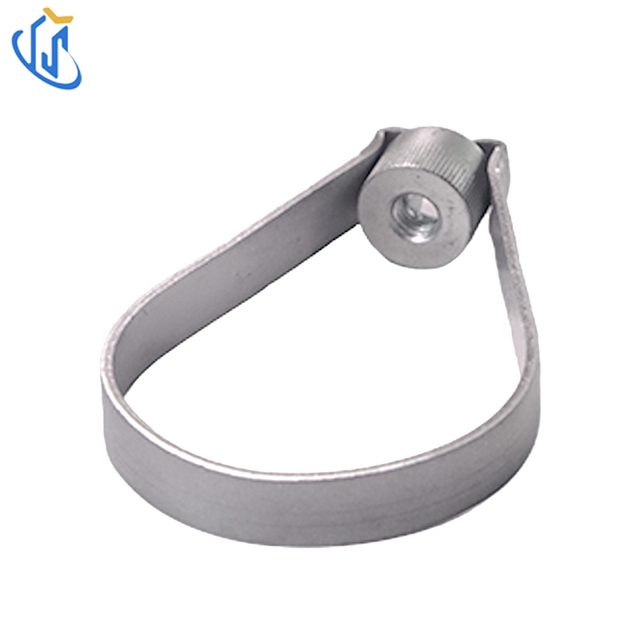
Let us examine the cost-to-outcome ratio carefully. Galvanized loop hangers present a lower per-unit material cost. You save money compared to buying heavy-duty clevis hangers. The real value comes from the knurled insert nuts. This swivel feature drastically reduces manual leveling time. Labor hours drop significantly across large commercial floors.
Common Mistake: Avoid specifying rigid band hangers for horizontal condensate lines. They lack the swivel adjustment necessary for fast post-install pitch corrections. You will struggle to pass drainage inspections.
Contractors often underestimate the cumulative time lost to static hangers. Adjusting just one rigid hanger takes several minutes. Multiply this across thousands of linear feet. You lose weeks of productivity. Swivel mechanisms eliminate this dead time. Installers simply spin the nut to achieve perfect elevation.
Solution Comparison: Loop Hangers vs. Alternative Support Systems
Selecting the right suspension method requires careful comparison. Different applications demand specific load tolerances. Let us look at how they stack up.
Loop Pipe Hanger vs. Clevis Hangers
Through an evaluation lens, loop hangers prove optimal for basic setups. They work perfectly for standard HVAC water lines. They provide highly reliable stationary pipe support. Clevis hangers serve a completely different purpose. You need clevis models for larger diameter pipes. They handle significant lateral movement safely. They also accommodate heavier, thick insulation shields easily.
Adjustable Loops vs. Perforated Strapping
Through another evaluation lens, perforated strapping lacks professional precision. Plumbers call it plumber's tape. It fails to meet code compliance for heavy loads. It offers zero post-install adjustability. Conversely, a Loop Pipe Hanger provides uniform load distribution. You get a reliable, professional finish every single time.
Skeptical Consideration
These hangers are not a universal fix. Heavy seismic zones require very different approaches. Outdoor coastal environments expose metals to harsh salt air. Engineers must specify rigid bracing in earthquake-prone areas. Standard galvanized loops fail under high vibration. Stainless steel alternatives outperform standard galvanized units outdoors.
Support Systems Analysis Chart
System Type
Best Application
Adjustability
Code Compliance (Div 23)
Adjustable Loop Hanger
Standard HVAC, Condensate
High (Post-install swivel)
High (Commercial Indoors)
Standard Clevis Hanger
Large Chilled Water Mains
Moderate (Requires tools)
High (Heavy Duty)
Perforated Strapping
Light residential ducts
None
Low (Often rejected)
Meeting Division 23 Compliance and Load-Bearing Standards
Commercial environments strictly enforce safety codes. Airports, universities, and municipal buildings require Division 23 compliance. Navigating engineering specifications ensures safe piping supports. Inspectors scrutinize these components closely. You must pass these visual inspections to secure occupancy permits.
Material verification remains a critical step. Galvanized steel offers a powerful zinc-coating defense. It protects against typical indoor humidity. It resists regular HVAC condensation easily. This metallic barrier prevents premature oxidation. Rust compromises structural integrity rapidly. Galvanization stops this degradation before it starts.
You must understand load ratings and safety factors. Always verify the manufacturer’s maximum recommended load (MRL). Do not guess these operational limits. Document the MRL clearly for inspector review. Testing laboratories establish these limits under strict conditions.
Remember where system vulnerabilities usually exist. The weakest point is rarely the hanger band itself. It is almost always the threaded rod. Upper structural attachments frequently fail first. Proper engineering reviews the entire suspended assembly. Beam clamps and drop-in anchors carry the primary burden.
Best Practice: Always use correctly sized structural anchors. Match the drop-in anchor capacity directly to the threaded rod. Ensure both exceed the loop hanger MRL. This creates a fail-safe suspension network.
Field Implementation: Sizing, Pitch Adjustments, and Retrofit Realities
HVAC systems require highly precise slopes. Condensate lines must drain perfectly via gravity. Mastering condensation drainage prevents severe building water damage. The adjustable swivel nut becomes your best tool. Contractors can micro-adjust the pitch effortlessly. You do this after the pipe rests safely in the hanger.
Retrofit scenarios present unique physical challenges. Existing commercial infrastructure often features uneven ceiling planes. Previous contractors leave chaotic utility pathways behind. Loop hangers adapt seamlessly to these environments. They integrate into existing drop-in anchors. You can attach them to existing beam clamps via standard threaded rods.
Installation risk mitigation protects your project timeline. Ensure the pipe size matches the hanger specification accurately. Loose hangers cause irritating system rattling. Tight hangers create severe pipe stress. Stress leads to premature material fatigue.
Follow these specific steps to adjust pitch safely:
Suspend the entire horizontal pipe run loosely across all brackets.
Place a digital torpedo level securely on the pipe surface.
Rotate the knurled insert nut manually on each individual hanger.
Lock the final elevation tightly once you achieve the required slope.
When dealing with insulated copper or steel pipes, proceed carefully. Ensure proper sizing before procurement. You must accommodate rigid insulation saddles. Sometimes you need curved protective shields. Do not compress the fiberglass insulation. Crushed insulation loses its thermal resistance. Do not compromise the hanger's structural band by forcing oversized loads.
Procurement Logic: Specifying the Right Hanger for the Project
Procurement requires strict evaluation logic. Buyers cannot rely on price alone. You must shortlist products based on specific physical dimensions. Failure here halts job site progress immediately.
Key Evaluation Dimensions for Shortlisting:
Gauge/Thickness: Verify the actual steel thickness. It must match your anticipated load classification perfectly. Thin metal deforms under heavy water weight.
Swivel Mechanism: Inspect the captured insert nut carefully. Does it lock securely? It must not strip under tension. Stripped threads drop pipes.
Certifications: Look for a valid UL Listing. Check for current FM Approval. These markers matter heavily. Applications overlapping fire protection demand them. Strict insurance underwriting also requires verified laboratory certifications.
Next-step actions secure absolute project success. Audit your upcoming project’s pipe schedule thoroughly. Determine the exact required hanger sizes per floor. Request comprehensive technical submittals from the manufacturer. Ask for a localized pull-test before bulk procurement.
Procurement Sizing Considerations
Pipe Material
Insulation Status
Sizing Rule
Bare Copper
Uninsulated
Match exact OD (Outside Diameter)
Black Iron
Uninsulated
Match exact nominal pipe size
Chilled Water
Thick Insulation
Size for Pipe OD + Insulation + Saddle
Engineers appreciate contractors who submit accurate technical sheets. It accelerates the approval process. Gather all load rating documents early. Store them digitally for quick reference during site inspections.
Conclusion
Adjustable galvanized loop pipe hangers deliver exceptional value. They serve as a reliable, code-compliant component. They successfully standardize commercial HVAC pipe suspension. These components streamline on-site labor through rapid adjustability. You eliminate hours of frustrating manual rework.
However, rigorous adherence to sizing standards dictates long-term success. You must strictly follow load limits. Proper implementation ensures a durable system. You protect the building from catastrophic pipe failures.
Consult a structural engineer early in your planning phase. Review all Division 23 requirements carefully. Map your loop hanger specifications strictly to your upcoming HVAC pipe schedule. Contact a technical sales representative today to finalize your procurement strategy.
FAQ
Q: What is the difference between a standard loop hanger and a swivel loop hanger?
A: A swivel loop includes a captured knurled nut at the top, allowing the installer to rotate the hanger to adjust vertical elevation on the threaded rod without dismantling the pipe.
Q: Can galvanized loop pipe hangers be used outdoors?
A: While galvanized steel resists rust better than bare steel, it is primarily intended for indoor, non-corrosive environments. Outdoor or highly corrosive applications usually require hot-dip galvanized or stainless steel hangers.
Q: How do I size a loop hanger for insulated HVAC pipes?
A: You must size the hanger based on the outside diameter (OD) of the pipe plus the thickness of the insulation and any required protective shields or saddles, rather than the bare pipe diameter alone.
Q: Are loop pipe hangers suitable for vertical pipe support?
A: No. Loop hangers are designed to suspend horizontal pipe runs. Vertical pipes require riser clamps that rely on friction and structural resting points to bear the load.
Utterly TY Intelligent Technology Co.,Ltd. is a high-tech private enterprise integrating product design, research and development, sales and installation.